


Teams rarely fail because they lack smart people. In our experience, they struggle when people judge the same situation by different inner standards and never say so out loud. One person protects speed. Another protects fairness. Another protects trust. The meeting looks calm, but the tension is real.
Values-based decision-making means choosing actions that match the principles a team claims to stand for.
That sounds simple. It is not. When pressure rises, people often return to habit, fear, or short-term gain. We have seen this happen in hiring, budget cuts, client service, and conflict between departments. Good intentions disappear fast when there is stress.
A 2025 study on decision habits among experienced professionals showed a striking gap: many people trust their judgment, yet many still lack clear decision routines. We think this matters for teams because confidence can hide inconsistency. If we want better choices, we need more than talent. We need a shared way to think.
Start with shared language
The first step is not a workshop full of abstract words on sticky notes. We need plain language. If a team says it values respect, what does that mean during disagreement? If it says it values accountability, what behavior should be visible when someone misses a deadline?
We suggest naming five to seven team values and defining each one in daily terms. Keep it concrete. Keep it observable.
Respect: We let people finish speaking before we challenge their view.
Honesty: We share risks early, even when the news is uncomfortable.
Responsibility: We own both the choice and its effect on others.
Fairness: We use the same standards across people and situations.
When values stay vague, they turn into decoration. When they are defined in behavior, they begin to guide real choices.
Clear values reduce hidden conflict.
Bring values into real decisions
Many teams discuss values in one meeting and forget them in the next one where an actual decision must be made. That gap is where trust starts to weaken. We think values should appear inside normal team routines, not outside them.
One practical way is to use a short set of questions whenever a decision has people, money, timing, or reputation at stake.
What decision are we making?
Who will be affected by it?
Which team values are most relevant here?
What option best matches those values?
What trade-off are we accepting?
How will we explain this choice clearly?
A values-based process does not remove trade-offs, but it makes them visible and discussable.
That last point matters. Teams often avoid naming the cost of a decision. But mature leadership is not pretending every good choice is easy. It is being honest about what we are protecting and what we are giving up.

Make reflection part of leadership
Before a team can decide by values, leaders need to slow the pace just enough for reflection. Not for delay. For clarity. We have noticed that many poor decisions are not made by bad people. They are made by rushed people.
A short pause can change the tone of a room. We might ask, “Are we choosing from pressure or from principle?” That question can reset the discussion in seconds.
There is also evidence that values and systems do not always match. An IMD survey on leadership values and organizational rewards pointed to a gap between what leaders personally value and what their systems reward. We see this often. People say they care about long-term trust, but their metrics reward short-term wins. If we ignore that tension, the team will notice. And they will learn what really counts.
Teams believe repeated behavior more than stated values.
That is why leadership example matters so much. If we ask for openness but punish bad news, people go silent. If we speak about fairness but make exceptions for convenience, cynicism grows. Small contradictions shape culture faster than formal statements do.
Use disagreement as a source of clarity
Values-based decision-making does not mean everyone agrees. In fact, real values often become visible during disagreement. That can be uncomfortable, but it is useful.
We remember a team discussion about whether to take on a demanding client request with a very short deadline. One group focused on commitment and service. Another focused on sustainability and respect for team limits. Both sides were speaking from values. The shift came when the team stopped arguing about who cared more and started asking which value had priority in that case, and why.
That is a better conversation.
When conflict appears, we can guide it with a few rules:
Name the value behind each position.
Ask what risk comes from ignoring that value.
Look for the value tension, not the villain.
Choose the path the team can explain with integrity.
This method reduces blame. It also improves respect, because people feel heard at the level that matters most.
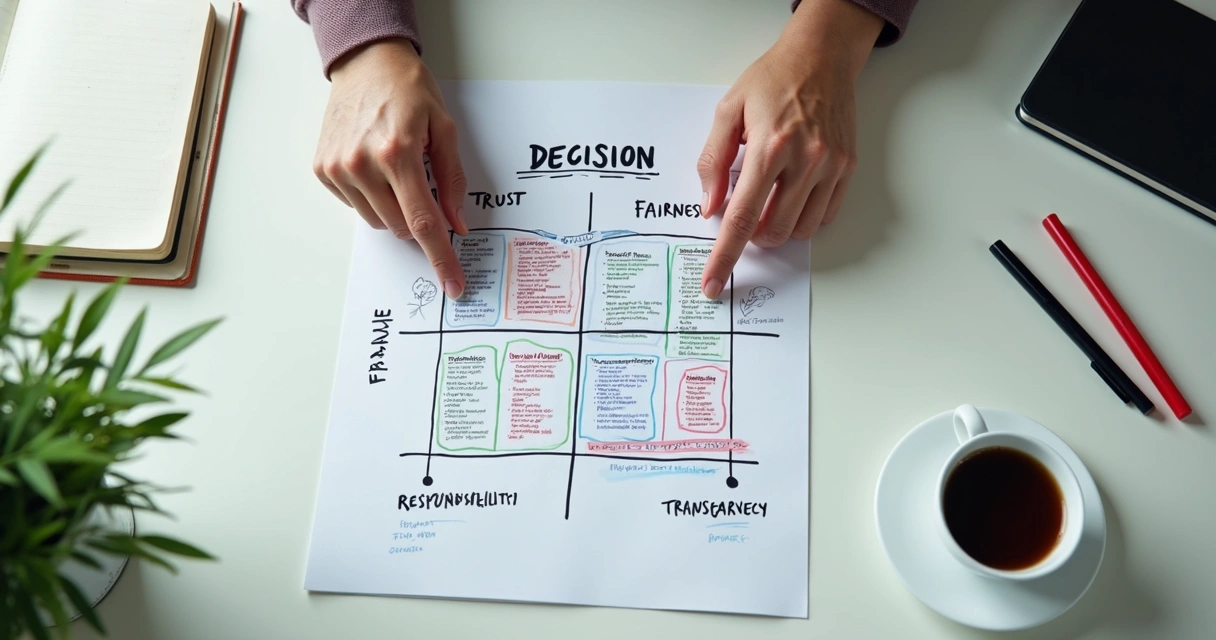
Build simple habits, not grand speeches
Teams do not need dramatic culture campaigns to improve decisions. They need repeatable habits. A healthcare ethics discussion published in research on values-based decision-making in organizations suggested that bringing ethics into decisions helps balance competing goals in a more responsible way. We think the lesson applies well beyond healthcare. Values become useful when they are built into ordinary choices.
We suggest a few habits that are easy to keep:
Begin major decision meetings by naming the values at stake.
Record not only the decision, but the reason behind it.
Review one past decision each month and ask if it matched team values.
Include values fit in hiring, feedback, and promotion talks.
Short habits create cultural memory. Over time, people stop asking, “What do we want right now?” and start asking, “Who are we when we choose?”
Conclusion
Values-based decision-making is not soft, vague, or slow. It is disciplined. It asks us to match judgment with character, and results with responsibility. In our view, teams become stronger when they stop treating values as posters on a wall and start using them as standards in tense moments, unclear moments, and high-stakes moments.
If we want a team that people trust, we have to help it make choices that people can respect. That takes language, practice, honesty, and example. Not perfection. Just coherence.
Values show most when pressure is high.
Frequently asked questions
What is values-based decision-making?
Values-based decision-making is the practice of choosing actions according to shared principles such as honesty, fairness, respect, or responsibility. It helps a team judge options not only by short-term gain, but also by whether the choice matches the standards the group wants to live by.
How to identify team core values?
We can identify team core values by looking at repeated behaviors, key tensions, and the standards people expect from one another. A good process is to ask what behaviors build trust, what actions damage trust, and what principles should guide the team under pressure. Then we narrow the list to a few values and define each one in clear, daily language.
Why use values in decision-making?
Values help teams stay consistent, fair, and credible. They reduce confusion when choices are hard and make it easier to explain decisions to others. They also support trust, because people can see that decisions come from shared standards rather than personal preference or hidden pressure.
What are examples of values-based decisions?
Examples include telling a client about a risk early because the team values honesty, refusing to overload staff because the team values respect, using the same promotion criteria for everyone because the team values fairness, or choosing a slower path that protects quality because the team values responsibility.
How can values solve team conflicts?
Values can solve team conflicts by shifting the focus away from personalities and toward principles. Instead of arguing about who is right, the team can ask which values are in tension, what each person is trying to protect, and which option best fits the team’s standards. This creates a calmer and more respectful way to resolve disagreement.